Monday, March 26, 2007


Thursday, March 22, 2007
Moron Moments - Frankie Gallagher UPRG
After the threat of implementing water charges in order to drive the electorate to the polls, the British Government has today announced it will throw £1 million at the Ulster Defence Association, clearly in an attempt to secure unionist support of a new assembly at Stormont.
I'll not bother complaining about how this expenditure is to be delivered to an armed and active paramilitary group, while many small charities are forced to downsize or close due to a lack of government funding. I've done this already: here and here.
Frankie Gallagher of the Ulster Political Research Group, a thinly veiled front for the UDA, appeared on BBC Radio Ulster this morning and tried vainly to justify the merits of this latest funding package. He noted that the loyalist community and the loyalist paramilitaries are one and the same and explained ongoing loyalist violence and racketeering as resulting from the actions of criminals using the good name of the UDA.
Amid the squall of bleats and excuses that ensued, came this wonderful gem of clarity from Mr Gallagher: "We're on the long march, like Ho Chi Minh and all the other Chinese philosophers who did that."
Such is the intellectual capacity of the UPRG and all who sail within it.
Rather than complain any further, I suggest that Mr Gallagher invests his glittering prize in the establishment of an education centre as a matter of grave urgency.
I'll not bother complaining about how this expenditure is to be delivered to an armed and active paramilitary group, while many small charities are forced to downsize or close due to a lack of government funding. I've done this already: here and here.
Frankie Gallagher of the Ulster Political Research Group, a thinly veiled front for the UDA, appeared on BBC Radio Ulster this morning and tried vainly to justify the merits of this latest funding package. He noted that the loyalist community and the loyalist paramilitaries are one and the same and explained ongoing loyalist violence and racketeering as resulting from the actions of criminals using the good name of the UDA.
Amid the squall of bleats and excuses that ensued, came this wonderful gem of clarity from Mr Gallagher: "We're on the long march, like Ho Chi Minh and all the other Chinese philosophers who did that."
Such is the intellectual capacity of the UPRG and all who sail within it.
Rather than complain any further, I suggest that Mr Gallagher invests his glittering prize in the establishment of an education centre as a matter of grave urgency.
Sunday, March 18, 2007
Big Bad Cahal Daly

Inspired by the Northern Ireland Press Photographers Association, whose work is currently on display at the Ormeau Baths Gallery in Belfast.
Tuesday, March 13, 2007
Assembly Election Blues
Forgive me for failing to wade into the arena of political commentary associated with the most recent elections. I’ve grown tired of the whole miserable and predictable affair. At least one consolation of the outcome is the relegation of Bob McCartney, Diane Dodds and Paul Berry to the skip of political history, although McCartney’s overwhelming vanity will doubtless prompt a reawakening, much in the mould of a returning Buffy villain.
And forgive me for not joining in with the mewling of appreciation directed by all and sundry at newly elected Alliance member, Anna Lo.
I recall Mrs Lo appearing on TV some years back, when loyalists were condemning the Chinese community for daring to consider Donegall Pass in Belfast as the location for their new community centre. Leaflets were circulated noting that the proposals for the new centre ‘undermines the community’s Britishness.’
At the time, Mrs Lo said nothing of the racism inherent in loyalism, failed to point her finger at the villains and ended up issuing only oblique comments on Chinese people not being accepted. Perhaps the beleaguered Chinese community feared that any criticism directed at the loyalist tormentors would result in attacks against them. Unfortunately, it’s not an untypical response from minority groups faced with such intolerance.
In Northern Ireland, there is a belief that minority communities tend to shy away from any identification with the orange and green landscape that surrounds them. A friend of mine pointed out that he felt many immigrants tended to subtly align themselves with political unionism, since it’s the dominant culture and to do otherwise would be to cast oneself as opposed to the state.
I’ve sometimes found that, within the gay community in Northern Ireland, many of the male-dominated groups tend to gravitate towards a unionist ethic, despite the unionist political parties having displayed a woeful and homophobic gay rights record. I think this alignment has something to do with a need for queer activists to engage with Westminster in an attempt to overturn homophobic legislation.
Lesbian groups, on the other hand, lacking any British legislation directed against them, haven’t needed to talk to Westminster to the same extent, which perhaps explains the existence of a more visible republican ethic in many lesbian groups here.
Limitations aside, the gay community (or should that be communities) in Northern Ireland has made many efforts to engage with ethnic minority groups. However, within the ethnic minority communities, there exists an inability – or refusal – to join with the queers in opposition to all kinds of intolerance, no matter where it comes from or what shape it takes. I’ve attended many meetings and rallies where the drive to combat racism is shouted from platforms by the usual faces, without homophobia ever being mentioned. It’s as if the many homophobic attacks never happened, skilfully airbrushed away to placate the apologists for religious dogma who prevail within some anti-racist circles.
I don't want to be too hard on Anna Lo. I'm sure she has achieved a great deal through her work for the Chinese community. However, when she demonstrates an ability to make the kind of minority community alliances that reach beyond those she's used to working with, then I’ll pay attention to what she has to say. Alas, I don’t expect it to happen anytime soon.
And forgive me for not joining in with the mewling of appreciation directed by all and sundry at newly elected Alliance member, Anna Lo.
I recall Mrs Lo appearing on TV some years back, when loyalists were condemning the Chinese community for daring to consider Donegall Pass in Belfast as the location for their new community centre. Leaflets were circulated noting that the proposals for the new centre ‘undermines the community’s Britishness.’
At the time, Mrs Lo said nothing of the racism inherent in loyalism, failed to point her finger at the villains and ended up issuing only oblique comments on Chinese people not being accepted. Perhaps the beleaguered Chinese community feared that any criticism directed at the loyalist tormentors would result in attacks against them. Unfortunately, it’s not an untypical response from minority groups faced with such intolerance.
In Northern Ireland, there is a belief that minority communities tend to shy away from any identification with the orange and green landscape that surrounds them. A friend of mine pointed out that he felt many immigrants tended to subtly align themselves with political unionism, since it’s the dominant culture and to do otherwise would be to cast oneself as opposed to the state.
I’ve sometimes found that, within the gay community in Northern Ireland, many of the male-dominated groups tend to gravitate towards a unionist ethic, despite the unionist political parties having displayed a woeful and homophobic gay rights record. I think this alignment has something to do with a need for queer activists to engage with Westminster in an attempt to overturn homophobic legislation.
Lesbian groups, on the other hand, lacking any British legislation directed against them, haven’t needed to talk to Westminster to the same extent, which perhaps explains the existence of a more visible republican ethic in many lesbian groups here.
Limitations aside, the gay community (or should that be communities) in Northern Ireland has made many efforts to engage with ethnic minority groups. However, within the ethnic minority communities, there exists an inability – or refusal – to join with the queers in opposition to all kinds of intolerance, no matter where it comes from or what shape it takes. I’ve attended many meetings and rallies where the drive to combat racism is shouted from platforms by the usual faces, without homophobia ever being mentioned. It’s as if the many homophobic attacks never happened, skilfully airbrushed away to placate the apologists for religious dogma who prevail within some anti-racist circles.
I don't want to be too hard on Anna Lo. I'm sure she has achieved a great deal through her work for the Chinese community. However, when she demonstrates an ability to make the kind of minority community alliances that reach beyond those she's used to working with, then I’ll pay attention to what she has to say. Alas, I don’t expect it to happen anytime soon.
Sunday, March 11, 2007
ChildLine

Inspired by the Northern Ireland Press Photographers Association, whose work is currently on display at the Ormeau Baths Gallery in Belfast.
Tuesday, February 27, 2007
Swimming Pool Chemicals
After a streaming and red-eyed experience while swimming in a local pool, I got in touch with Belfast City Council to see if they could let me know what chemicals are used in council swimming pools. After a long wait, I got the following list of chemicals from the manager of the pool:
Calcium Hypochlorite tablets are used to generate Chlorine that is required to destroy the organic contaminants in the water.
Poly Aluminium Chloride is a flocculation agent which helps the sand filters to remove very finely suspended matter and algae, colouring matter and a portion of the bacteria in the water.
CO2 gas is used for pH control while Ozone and UV treatment is used for pool disinfection and helps reduce the level of chlorine required in the pool.
Liquid Algaecide kills or inhibits the multiplication of algae in the pool.
Sodium Bicarbonate is used to raise pH while Sodium Bisulphate is used to lower pH.
Chlorine is used in all Belfast City Council pools. A few pools in the UK use Bromine-based disinfectants but apparently there are doubts about the evidence for their effectiveness as compared to chlorine-based disinfectants. With heavy bather loads, such as in Belfast pools, Chlorine use is recognised as best practice within the industry.
After an on-line search, I found this site, which explains that eye irritation usually arises because of an inadequate water-balancing process (i.e. the relationship of different chemicals to each other in the pool). Therefore, it would appear that the red eyes occurred due to an inadequate amount of chlorine in the pool.
Calcium Hypochlorite tablets are used to generate Chlorine that is required to destroy the organic contaminants in the water.
Poly Aluminium Chloride is a flocculation agent which helps the sand filters to remove very finely suspended matter and algae, colouring matter and a portion of the bacteria in the water.
CO2 gas is used for pH control while Ozone and UV treatment is used for pool disinfection and helps reduce the level of chlorine required in the pool.
Liquid Algaecide kills or inhibits the multiplication of algae in the pool.
Sodium Bicarbonate is used to raise pH while Sodium Bisulphate is used to lower pH.
Chlorine is used in all Belfast City Council pools. A few pools in the UK use Bromine-based disinfectants but apparently there are doubts about the evidence for their effectiveness as compared to chlorine-based disinfectants. With heavy bather loads, such as in Belfast pools, Chlorine use is recognised as best practice within the industry.
After an on-line search, I found this site, which explains that eye irritation usually arises because of an inadequate water-balancing process (i.e. the relationship of different chemicals to each other in the pool). Therefore, it would appear that the red eyes occurred due to an inadequate amount of chlorine in the pool.
Thursday, February 08, 2007
Education Electioneering
Electioneering swung into sharp focus this morning when a gaggle of local politicians were wheeled into BBC Radio Ulster’s odious Nolan Show. The discussion (and I hesitate to use this word; ‘rant’ would be more appropriate) centered on integrated education while Nolan snorted and waved his arms in a display of predictable indignation. The entire episode reminded me of a 1970s James Young sketch, wherein various personalities exercised their sectarianism for cheap laughs. How little things have changed.
I didn’t catch the name of the Ulster Unionist representative, but he wasn’t one of the inner luminaries I recognised. He noted he was once in the UDR and squeaked for a little about terrorists in government. The DUP’s Iris Robinson upheld the state system and attacked integrated education, addressing Sinn Fein’s Catriona Ruanne as ‘That lady,’ while Ms Ruanne accused Mrs Robinson of playing the sectarian card. So far, so typical.
However, it was the SDLP’s Carmel Hannah who brought the quarrel to a depressing low in her description of local schools as either ‘Catholic schools’ or ‘Protestant schools’ thus underlining the sectarianism which I imagine is inherent in her party’s education policy. I was reminded of Richard Dawkins’ warning that we should never refer to children, for example, as ‘Catholic children’ but as ‘Children of Catholic parents’. The children are blank slates until they are conditioned, like Pavlov’s dogs, by zealous elders. Dawkins goes further and describes such contamination of child minds as akin to child abuse.
The squabble didn’t progress any further than these surface issues. No one was capable, or willing, to initiate an argument for the introduction of a secular education system. Ms Ruanne made the most coherent arguments, but stopped short of condemning the Catholic Church’s influence on schooling.
There was no mention of her own party’s mixed messages regarding the Private Finance Initiative – a government scheme which allows private companies to make huge profits through capital investment in the building of schools and hospitals. Indeed, during his brief tenure as education minister, Martin McGuinness acted like a master illusionist when he abolished the eleven-plus selection test with one hand, while administering PFI schemes with the other.
However, it would appear that the party has since backtracked on its support for PFI. In the introduction to a twenty-one-page policy paper on its website, Sinn Fein now condemns PFI as “An effort by the British Treasury to tighten its control over northern fiscal policy and to privatise public services.” Quite.
For a more coherent overview of the horrors of PFI, I suggest a trip to this article on George Monbiot’s site.
Meanwhile, I see that the Association for Quality Education (an alliance of groups opposed to the introduction of comprehensive education in Northern Ireland) has decreed that 'Computer Adaptive Testing' be considered in order to determine which child goes to which school. In short, the computer will decide. It's like something from dystopian fiction and conjures up images of rows of blank-faced children, plugged into flickering computer monitors while Stephen Nolan's missives ring in their ears.
I didn’t catch the name of the Ulster Unionist representative, but he wasn’t one of the inner luminaries I recognised. He noted he was once in the UDR and squeaked for a little about terrorists in government. The DUP’s Iris Robinson upheld the state system and attacked integrated education, addressing Sinn Fein’s Catriona Ruanne as ‘That lady,’ while Ms Ruanne accused Mrs Robinson of playing the sectarian card. So far, so typical.
However, it was the SDLP’s Carmel Hannah who brought the quarrel to a depressing low in her description of local schools as either ‘Catholic schools’ or ‘Protestant schools’ thus underlining the sectarianism which I imagine is inherent in her party’s education policy. I was reminded of Richard Dawkins’ warning that we should never refer to children, for example, as ‘Catholic children’ but as ‘Children of Catholic parents’. The children are blank slates until they are conditioned, like Pavlov’s dogs, by zealous elders. Dawkins goes further and describes such contamination of child minds as akin to child abuse.
The squabble didn’t progress any further than these surface issues. No one was capable, or willing, to initiate an argument for the introduction of a secular education system. Ms Ruanne made the most coherent arguments, but stopped short of condemning the Catholic Church’s influence on schooling.
There was no mention of her own party’s mixed messages regarding the Private Finance Initiative – a government scheme which allows private companies to make huge profits through capital investment in the building of schools and hospitals. Indeed, during his brief tenure as education minister, Martin McGuinness acted like a master illusionist when he abolished the eleven-plus selection test with one hand, while administering PFI schemes with the other.
However, it would appear that the party has since backtracked on its support for PFI. In the introduction to a twenty-one-page policy paper on its website, Sinn Fein now condemns PFI as “An effort by the British Treasury to tighten its control over northern fiscal policy and to privatise public services.” Quite.
For a more coherent overview of the horrors of PFI, I suggest a trip to this article on George Monbiot’s site.
Meanwhile, I see that the Association for Quality Education (an alliance of groups opposed to the introduction of comprehensive education in Northern Ireland) has decreed that 'Computer Adaptive Testing' be considered in order to determine which child goes to which school. In short, the computer will decide. It's like something from dystopian fiction and conjures up images of rows of blank-faced children, plugged into flickering computer monitors while Stephen Nolan's missives ring in their ears.
Wednesday, January 24, 2007
Moron Moments - Lord Maginnis
Since the Police Ombudsman's unmasking of the RUC as a corrupt entity, unionist opinion has been muted or steeped in denial.
Over the last few days, Lord Maginnis has provided the loudest voice of opposition to Nuala O'Loan's investigation.
The Ombudsman's report noted that, between 1991 and 2003, RUC Special Branch paid £79,840 to a prominent UVF member who was acting as a police informer. They protected this informer (cited as Informer One) and other informers, and facilitated situations in which informants were able to continue to engage in paramilitary activity. Informer One was involved in ten murders, ten attempted murders, the targeting of an individual for murder, a bomb attack in Monaghan in 1997 and various paramilitary attacks, drug dealing and other criminal acts.
In the course of her investigation, the Police Ombudsman noted that several retired, high ranking officers either refused to cooperate, lied, attempted to obstruct the investigation or gave "farcical" answers, illustrating a "Contempt for the law".
Important documents went missing, were lost or destroyed. Evidence was withheld or concealed. Sham interviews with informants were conducted by Special Branch handlers, misleading interview notes were created and informers were released without charge. On one occasion, Special Branch officers discovered munitions at an informers home and did nothing about it. Junior officers were instructed that records should not be completed and forensic exhibits were destroyed.
On another occasion, after witnesses noted the killer of Gary Convie and Eamon Fox had a goatee beard, Special Branch officers allowed Informer One to shave off his goatee while in police custody.
In short, following in the footsteps of Stalker, Stevens, Cory and Barron, Mrs O'Loan has demonstrated what many already knew or suspected - that the RUC was routinely colluding with loyalist paramilitaries.
 Confronted with this damning expose, Lord Maginnis has been barking and bullying his way though a series of TV and radio interviews, demonstrating that he is unable to construct a single, coherent argument to support his accusations that Mrs O'Loan is wrong. Instead, he shoots the messenger, attacks the integrity of the Ombudsman and accuses her staff of ineptitude.
In his apparent role of loyalist totem, through which all unionist psychology is channeled, Lord Maginnis dismisses the report as republican propaganda. His protestations are akin to those of a sex offender who refuses to accept he has done anything wrong, despite clear evidence to the contrary. Such is the nature of the unionist psyche.
Unionists seem unable or unwilling to accept the truth - that their empire was built on discrimination, corruption, collusion and cover-up. Instead of facing up to the realities of the past, Maginnis and his cronies clutch at straws, shriek with unfocused hysteria, point fingers and defend the agents of depravity as their vile little world frays at the edges.
"We've a great deal more experience than the Police Ombudsman's staff," shrieked Maginnis, during a TV interview on Monday. Quite who this "We" refers to is unclear, although it must be noted that Maginnis is an ex-UDR member, an organisation which was riddled with loyalist paramilitarists and had nineteen of its members convicted of murder.
The finding of the Police Ombudsman can not be allowed to be swept under the carpet. It is important that a full, public enquiry be conducted into this issue and that criminal prosecutions follow. The RUC should be stripped of its George Cross and Sir Ronnie Flannigan, Chief Constable of the RUC during the period of the investigation, should be held accountable and sacked as HM Inspectorate of Constabulary.
Detractors howl in derision at the notion of a public enquiry, citing the cost as prohibitive, although one can only guess how much money is spent on terrorising the citizens of Iraq, where former RUC officers, made redundant as a result of the Patten reforms of policing, now serve as private security contractors.
Indeed, one wonders if the disgusting tactics of the RUC have been exported from these shores and are now alive and kicking in Basra, Fallujah and Baghdad.
Over the last few days, Lord Maginnis has provided the loudest voice of opposition to Nuala O'Loan's investigation.
The Ombudsman's report noted that, between 1991 and 2003, RUC Special Branch paid £79,840 to a prominent UVF member who was acting as a police informer. They protected this informer (cited as Informer One) and other informers, and facilitated situations in which informants were able to continue to engage in paramilitary activity. Informer One was involved in ten murders, ten attempted murders, the targeting of an individual for murder, a bomb attack in Monaghan in 1997 and various paramilitary attacks, drug dealing and other criminal acts.
In the course of her investigation, the Police Ombudsman noted that several retired, high ranking officers either refused to cooperate, lied, attempted to obstruct the investigation or gave "farcical" answers, illustrating a "Contempt for the law".
Important documents went missing, were lost or destroyed. Evidence was withheld or concealed. Sham interviews with informants were conducted by Special Branch handlers, misleading interview notes were created and informers were released without charge. On one occasion, Special Branch officers discovered munitions at an informers home and did nothing about it. Junior officers were instructed that records should not be completed and forensic exhibits were destroyed.
On another occasion, after witnesses noted the killer of Gary Convie and Eamon Fox had a goatee beard, Special Branch officers allowed Informer One to shave off his goatee while in police custody.
In short, following in the footsteps of Stalker, Stevens, Cory and Barron, Mrs O'Loan has demonstrated what many already knew or suspected - that the RUC was routinely colluding with loyalist paramilitaries.
 Confronted with this damning expose, Lord Maginnis has been barking and bullying his way though a series of TV and radio interviews, demonstrating that he is unable to construct a single, coherent argument to support his accusations that Mrs O'Loan is wrong. Instead, he shoots the messenger, attacks the integrity of the Ombudsman and accuses her staff of ineptitude.
In his apparent role of loyalist totem, through which all unionist psychology is channeled, Lord Maginnis dismisses the report as republican propaganda. His protestations are akin to those of a sex offender who refuses to accept he has done anything wrong, despite clear evidence to the contrary. Such is the nature of the unionist psyche.
Unionists seem unable or unwilling to accept the truth - that their empire was built on discrimination, corruption, collusion and cover-up. Instead of facing up to the realities of the past, Maginnis and his cronies clutch at straws, shriek with unfocused hysteria, point fingers and defend the agents of depravity as their vile little world frays at the edges.
"We've a great deal more experience than the Police Ombudsman's staff," shrieked Maginnis, during a TV interview on Monday. Quite who this "We" refers to is unclear, although it must be noted that Maginnis is an ex-UDR member, an organisation which was riddled with loyalist paramilitarists and had nineteen of its members convicted of murder.
The finding of the Police Ombudsman can not be allowed to be swept under the carpet. It is important that a full, public enquiry be conducted into this issue and that criminal prosecutions follow. The RUC should be stripped of its George Cross and Sir Ronnie Flannigan, Chief Constable of the RUC during the period of the investigation, should be held accountable and sacked as HM Inspectorate of Constabulary.
Detractors howl in derision at the notion of a public enquiry, citing the cost as prohibitive, although one can only guess how much money is spent on terrorising the citizens of Iraq, where former RUC officers, made redundant as a result of the Patten reforms of policing, now serve as private security contractors.
Indeed, one wonders if the disgusting tactics of the RUC have been exported from these shores and are now alive and kicking in Basra, Fallujah and Baghdad.
Thursday, January 18, 2007
David Ervine is the New George Best
Following its tedious and interminable coverage of the passing of George Best last year, BBC Radio Ulster continues to wallow in its cult of celebrity death. This time, David Ervine of the Progressive Unionist Party is the subject of adoration.
Mr Ervine died just over a week ago and, as expected, BBC Northern Ireland's airwaves have since been awash with lachrymose eulogies. Yesterday's edition of Talkback dedicated its first thirty-five minutes to mewing over Mr Ervine, often plumbing the most moronic and laughable depths.
One commentator noted that Mr Ervine was an icon for Protestant youth and a leader akin to Nelson Mandela and Martin Luther King. I restrained myself from falling off my chair at such comparisons, although I couldn't help my mouth falling open.
"He gave me hope for Ulster," said one caller. Another noted that perhaps a scholarship should be offered in Mr Ervine's name, or a college established to "help bring people together."
It was suggested that the new Northern Irish stadium should be called 'The David Ervine Stadium' or that a bronze bust be located in City Hall.
The mewling and rending of garments continued. Blinding light poured from the radio. Phrases such as "The other persuasion" and "The Province" littered the discussion. Presenter, David Dunseith sighed with remorse. A pastor, and friend of Mr Ervine, spoke about hymns.
A caller noted: "I wish there was another airport we could name after him."
At this point, I abandoned restraint and fell off my chair.
Such is the state of reasoned journalism at BBC Radio Ulster. There was no significant exploration of Mr Ervine's role as a representative of an armed sectarian organisation committed to ensuring Unionist privelage through the killing of Catholics. Dissenting voices were absent, doubtless excised at the switchboard. Those whose comments managed to get read out were described as individuals unable to move on. The airbrushed cult of celebrity prevailed.
I searched for an antidote to these exaltations and came across this rather stark post by Liam Mac Uaid. I suggest Mr Mac Uaid be given a slot on Radio Ulster sometime this week, preferably just prior to Hugo Duncan's inane twittering, when an entire nation races for the off-switch.
Mr Ervine died just over a week ago and, as expected, BBC Northern Ireland's airwaves have since been awash with lachrymose eulogies. Yesterday's edition of Talkback dedicated its first thirty-five minutes to mewing over Mr Ervine, often plumbing the most moronic and laughable depths.
One commentator noted that Mr Ervine was an icon for Protestant youth and a leader akin to Nelson Mandela and Martin Luther King. I restrained myself from falling off my chair at such comparisons, although I couldn't help my mouth falling open.
"He gave me hope for Ulster," said one caller. Another noted that perhaps a scholarship should be offered in Mr Ervine's name, or a college established to "help bring people together."
It was suggested that the new Northern Irish stadium should be called 'The David Ervine Stadium' or that a bronze bust be located in City Hall.
The mewling and rending of garments continued. Blinding light poured from the radio. Phrases such as "The other persuasion" and "The Province" littered the discussion. Presenter, David Dunseith sighed with remorse. A pastor, and friend of Mr Ervine, spoke about hymns.
A caller noted: "I wish there was another airport we could name after him."
At this point, I abandoned restraint and fell off my chair.
Such is the state of reasoned journalism at BBC Radio Ulster. There was no significant exploration of Mr Ervine's role as a representative of an armed sectarian organisation committed to ensuring Unionist privelage through the killing of Catholics. Dissenting voices were absent, doubtless excised at the switchboard. Those whose comments managed to get read out were described as individuals unable to move on. The airbrushed cult of celebrity prevailed.
I searched for an antidote to these exaltations and came across this rather stark post by Liam Mac Uaid. I suggest Mr Mac Uaid be given a slot on Radio Ulster sometime this week, preferably just prior to Hugo Duncan's inane twittering, when an entire nation races for the off-switch.
Saturday, January 13, 2007
Belfast Street Art
 Here I present some of Belfast city centre’s street art.
This first selection is mainly from Mexican tattoo artist, Dr Lakra and Spanish artist, Geso.
Both artists were in Belfast last summer for Urban Eyes, an event organised by Belfast City Skinworks, Skullduggery Tatu and Catalyst Arts.
Aside from painting on walls, Dr Lakra, who has exhibited in London, Paris, Los Angeles and New York, also works graffiti over old magazine advertisements and found photographs of Mexican idols, masked wrestlers and pin-up girls.
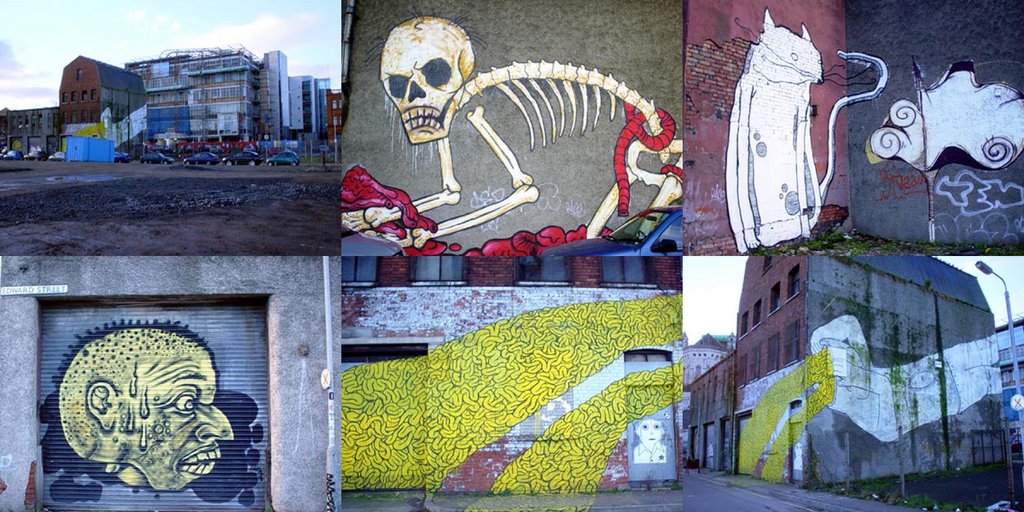 As much as I admire the Day of the Dead-style pictures, their location on a fine, redbrick, Victorian building irks me somewhat. I’ve walked past this outdoor gallery often, but only recently ventured down the derelict College Court to actually examine the works and take some photographs.
Alas, since then, the art has been attacked by Morlocks with spray-cans and some of the painted figures now sport crudely drawn genetalia from their heads and bodies.
This next collage of photographs is of the last building standing in Edward Street, also decorated by Dr Latka.
It probably won’t be long before it’s pulled down to make way for the new St Anne’s Square development (due for completion in Autumn 2008).
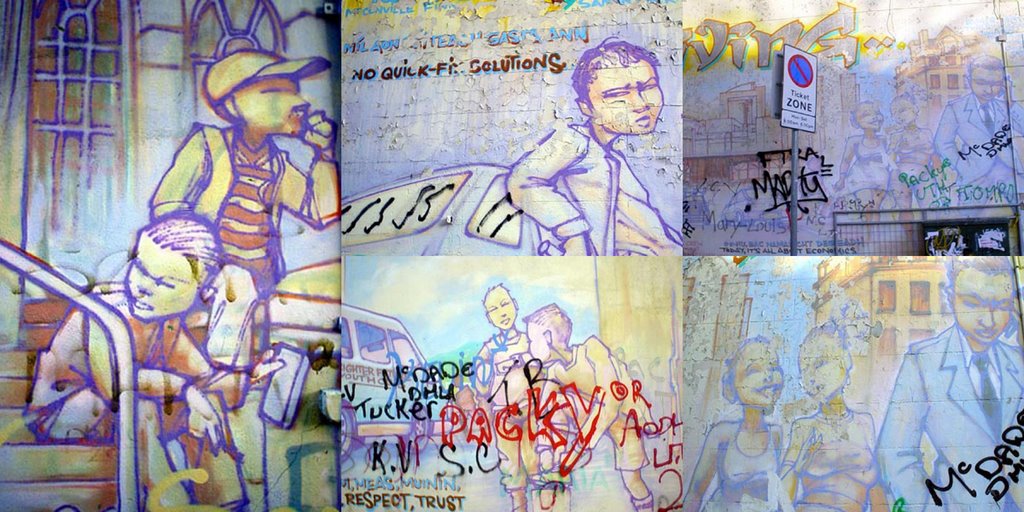 Finally, I present for posterity what’s left of a mural from renouned artist, Mode 2.
I think this piece, in College Place North, was realised in August 1998 when Mode 2 ran mural workshops in Belfast. The paint is peeling and the inept tags of local Morlocks have molested most of the original artwork.
I imagine it will soon be painted over to complement the nice new building, which has recently risen up alongside it.
Tuesday, December 12, 2006
Update on Unionist Homophobia
I've just discovered the transcript of the proceedings in the Transitional Assembly yesterday, when members debated over the new Sexual Orientation Regulations, designed to protect lesbian, gay and bisexual people from discrimination in the provision of goods and services.
All thirty-nine opponents to the regulations were either from the Ulster Unionist Party and the DUP. Those in favour included Sinn Fein, Alliance and SDLP. David Ervine of the Progressive Unionist Party was the only unionist to vote in support of the regulations.
The unionist argument was couched in Christian rhetoric. Caitriona Ruane of Sinn Fein noted the DUP's history of homophobia and accused the party of using homophobia for political gain.
Alex Maskey of Sinn Fein referred to Ian Paisley's various campaigns against gay rights: "For many of us, the history of the DUP — and perhaps, even more so, that of the Free Presbyterian Church — will lead many of us to believe that a strong homophobic strain runs through that strand of our society. Many of us believe that, and our belief is based on the experience of seeing many years of strong campaigns that were headed by the leader of the DUP, who is sitting on the Benches opposite."
Patricia Lewsley of the SDLP referred to the DUP as the "Discriminating as Usual Party."
Paul Berry, former-DUP golden boy, who last year was alleged to have engaged in a sex act with another male in a Belfast hotel, remained silent throughout the debate but voted with his former party-colleagues in opposing the introduction of the regulations.
This is an update of this post.
All thirty-nine opponents to the regulations were either from the Ulster Unionist Party and the DUP. Those in favour included Sinn Fein, Alliance and SDLP. David Ervine of the Progressive Unionist Party was the only unionist to vote in support of the regulations.
The unionist argument was couched in Christian rhetoric. Caitriona Ruane of Sinn Fein noted the DUP's history of homophobia and accused the party of using homophobia for political gain.
Alex Maskey of Sinn Fein referred to Ian Paisley's various campaigns against gay rights: "For many of us, the history of the DUP — and perhaps, even more so, that of the Free Presbyterian Church — will lead many of us to believe that a strong homophobic strain runs through that strand of our society. Many of us believe that, and our belief is based on the experience of seeing many years of strong campaigns that were headed by the leader of the DUP, who is sitting on the Benches opposite."
Patricia Lewsley of the SDLP referred to the DUP as the "Discriminating as Usual Party."
Paul Berry, former-DUP golden boy, who last year was alleged to have engaged in a sex act with another male in a Belfast hotel, remained silent throughout the debate but voted with his former party-colleagues in opposing the introduction of the regulations.
This is an update of this post.
Monday, December 11, 2006
Bad Art - Michael Stone
 In the wake of Michael Stone's recent attack on Stormont, many of the news reports noted that Stone was an artist, although none mentioned how amateurish his artworks actually are.
The pictures I've seen display no understanding of technique, composition or ability.
Two of his dreadful paintings appeared on eBay in the last week. One, entitled ‘Kneeling Nude on a Red Background’ had a ‘buy-it-now’ price of £9,995. It wasn’t met and the item mysteriously vanished from eBay before the auction closed.
A second, untitled, nude came with a signed photo of Stone posing by its “sister painting” which is entitled ‘Coeruleum Sunrise’. The bidding started at £4,000 and the auction closed this afternoon without any interest.
These works are really bad. The reds and blacks which act as a background to the nudes, coupled with the clumsy graphic style, suggest a boy's bedroom from the 1980s. The female nudes look as if they've been badly copied from a pornographic magazine.
 Bizarrely, the listings noted that a percentage of the sales would be donated to Relatives for Justice, a Northern Irish victims charity with offices on the Falls Road and an interest in uncovering British Army and RUC collusion in murder.
However, Stone's artistic nadir has to be a sculpture, currently on eBay with a starting price of £3,500. Behold the red hand, cast from a Glaswegian loyalist as it arises from a piece of bog oak, slate and a cog wheel.
I'm not quite sure what this piece is trying to convey. Perhaps, in his delusiory state, Stone thought that the presence of the bog oak provided him with some kind of artistic credibility. Alternatively, Stone may have recently become aware that his art was rubbish and decided to go back to the day job.
We all know what an exhibition that turned out to be.
Bad Art - Republican Sinn Fein
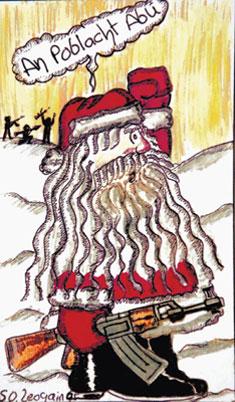 Today, the Belfast Telegraph printed a news story about Republican Sinn Fein’s Christmas card, complete with a picture (which I reproduce here). As you can see, the image is of Santa wielding an AK-47 rifle and uttering ‘Up the Republic’ in Irish.
As expected, hands were flung up in horror and words of condemnation were issued from the usual quarters.
However, none of the reports have mentioned that the artwork is truly awful. Isn’t there anyone in Republican Sinn Fein’s marketing department with an appreciation of art?
Illustrated cards of this standard are excusable if produced by a children’s charity. By releasing this inept and unsophisticated image, Republican Sinn Fein announces it isn’t a political organisation that should be taken seriously.
United Colours of Homophobia
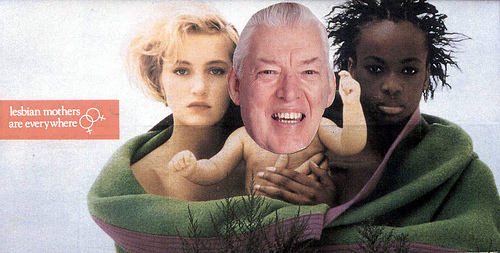 Today, the DUP and friends turned their attention to gay-baiting in an attempt to frustrate the progress of the new Sexual Orientation Regulations, which are designed to stop businesses discriminating against lesbian and gay people in the provision of goods and services.
Thirty-nine Assembly Members voted in favour of a motion condemning the British Government's plans to introduce the regulations. Thirty-nine voted against and the motion was rejected. The regulations will take effect from 1st January 2007.
Although Jeffrey Donaldson and George Dawson of the DUP led the charge against the Sexual Orientation Regulations, one can be comfortably assume that the vast majority, if not all of the other thirty-seven supporters of the motion were from within the Unionist bloc.
Unionist homophobic loathing was well illustrated during the introduction of civil partnerships for same-sex couples in 2005. The issue of whether or not to allow gay couples to use Lisburn City Council's wedding room threw unionism into such a tizzy that more than £20,000 of rate-payers' money was squandered seeking legal advice on dealing with the issue, only to find that any actions to block gays from the wedding room would be illegal.
At the time, Councillor Edwin Poots of the DUP likened homosexuality to alcoholism and drug addiction while the Ulster Unionist Ronnie Crawford said he was disgusted by gay websites that he had happened across in researching civil partnerships. How one happens across disgusting websites while researching government policy remains unclear. Perhaps, Mr Crawford strayed from the path to explore some of his own interests.
The comments by Jack McKee of the DUP demonstrate the influence of religious fundamentalism on political decision-making: "I believe that God made Adam from the dust of the ground and that he made woman from the rib of Adam and he made her as a helpmate for him. This is my personal belief and I believe it with all my life. I do not believe man came from monkeys, and all that."
DUP Councillor, Maurice Mills went a hilarious step further when he decreed that Hurricane Katrina was sent by God to punish the New Orleans' gay community since it arrived just days before the annual gay mardi gras. He's also an expert on the AIDS epidemic in Africa, noting that the "abominable and filthy practice of sodomy has resulted in the great continent of Africa being riddled with AIDS, all at great cost to the nations and innocent children." Quite.
This is what he said about the 2004 tsunami, which savaged parts of Asia: "These disasters are no coincidence, as God only honours those who honour him. I would ask why we don't see disasters like these taking place in Europe. Scripture says righteousness exalts nations. Asia is not a Christian continent."
In 2004, the DUP's Newtownabbey councillor, Arthur Templeton, was convicted of harassing a gay candidate during local government elections. Following the court case, he said he believed homosexuality was "Against God's teaching."
Examples of Templeton's behaviour are childish in the extreme. He apparently bent over in front of the man he was harassing, patted his backside and said, "Here you are, John." He also called him "queer" and offered to hold his hand while crossing the road.
Christian religious fundamentalism is so embedded within the Unionist political psyche that it's hard to see how any enlightened or progressive thinking can emerge from within it. Instead, we're transported to some weird, sepia-tinted parallel universe where everything revolves around the gospel hall and swings are padlocked on Sundays.
I'm reminded of the world conjured up by the BBC adaptation of Jeanette Winterson's 'Oranges Are Not The Only Fruit' where the reaction of evangelicals to discovering homosexuality in their midst is both chilling and comic.
Paul Berry must know something of this attitude. The former-DUP member and ardent gospel-singer, was suspended from the party in 2005 and then forced to resign after allegations surfaced that he had a sexual encounter with another man in a Belfast hotel. It transpired that Mr Berry's alleged sexual partner had arranged the whole affair as an elaborate trap in order to make a statement on DUP hypocrisy.
I wonder how Mr Berry voted today.
Monday, November 27, 2006
Moron Moments - Hain, Bell and Stone
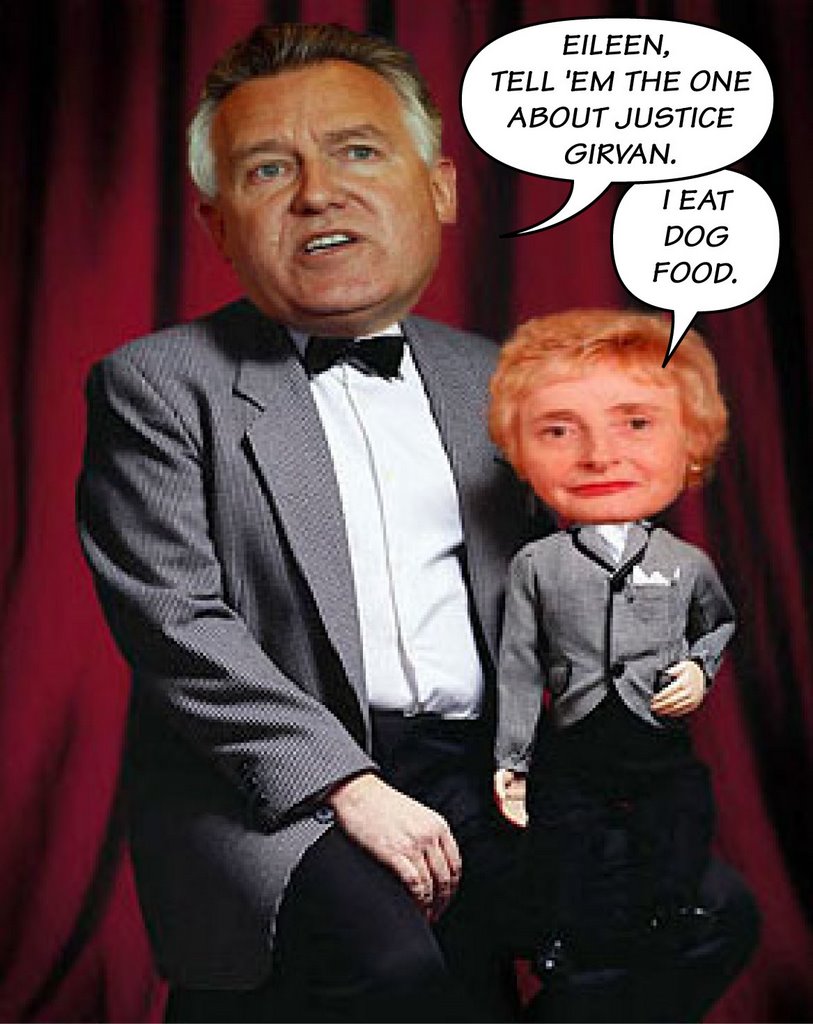 Local ventriloquist doll and Speaker of the Northern Ireland Assembly, Eileen Bell, has accomplished a feat that would have previously seemed impossible. She has ensured Ian Paisley's "No," actually means "Yes."
Although Dr Paisley noted on Friday that he was in no position to make a nomination to the Northern Ireland Assembly, due to Sinn Fein's inaction on policing, Mrs Bell announced otherwise.
The question must now be asked: why did we never sieze upon Mrs Bell's powers of double-speak long ago?
With Mrs Bell leading the vanguard, Paisley would have said, "Yes," to Sunningdale, the Anglo-Irish Agreement and the Good Friday Agreement. "Never, never, never!" would have been transformed into "Always, always, always!" Think of the bloodshed that would have been averted.
But, Mrs Bell was merely mouthing the words of Secretary of State for Northern Ireland, Peter Hain. It didn’t matter what was said in the Assembly chamber; Hain and the Northern Ireland Office ensured it was translated through their own political spin machines, for their own preferred ends.
And just when things couldn’t get any more ludicrous, enter stage right, former British agent, Michael Stone, equipped with an array of accessories including nail bombs, an axe, a garotte and a gun.
The attack that followed was darkly comic, particularly the scenes where Michael Stone's glasses were knocked off and the female security guard held his legs up while he lay on the ground, shouting like a mad thing.
Stone's reappearance was akin to the reactivation of a long dormant sleeper or resurgent comic-book villain. The fans didn't see that one coming. It was like the return of the Cybermen to 'Doctor Who' in 1982. How we fell off our seats in astonishment.
Either his actions were fuelled by mental illness, the desire for further celebrity or he was guided, like Mrs Bell, by some sinister intelligence.
Whatever the motivation behind Stone’s inept attack, it has acted as a successful distraction from the serious problems faced by Mr Hain.
The Secretary of State must recognise that his ambition for the role of Deputy Prime Minister is threatened by Mr Justice Girvan's call for an inquiry into the circumstances surrounding the appointment of the Victims' Commissioner.
To date, there has been no serious examination of this affair by either Westminster or the London media, proving that no one over there really cares about what goes on over here.
Perhaps, now that the High Court has orderd an inquiry into the illegal actions of Mr Hain, the need for the Northern Ireland Office to produce a spectacular diversion is upon us.
Wednesday, November 22, 2006
The Ugliest Street in Belfast
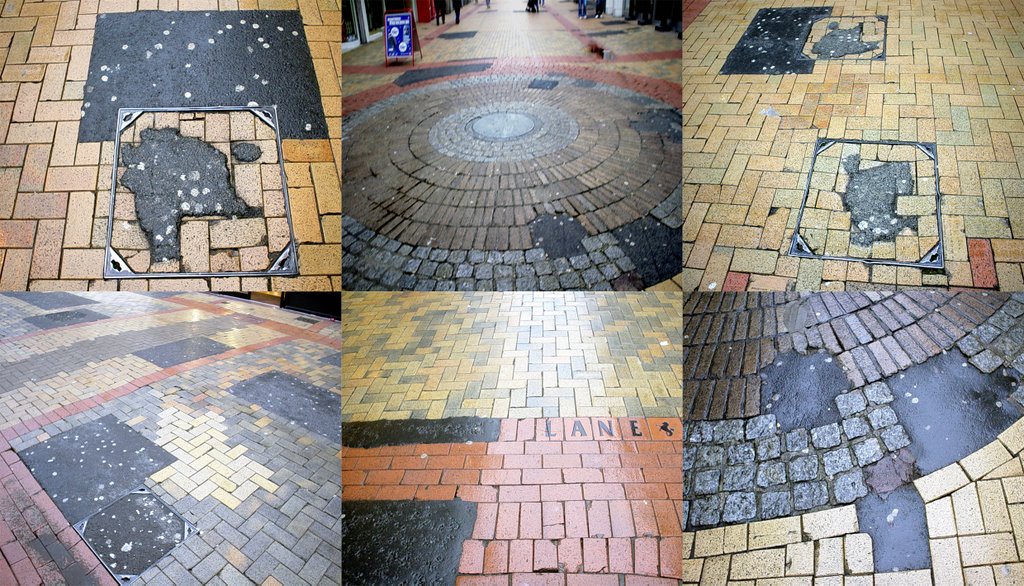 It has become a bit of a cliché to note that most people walk around cities without ever looking up at some of the architectural wonders ranged above them. I would suggest that people look down when out walking, particularly in Belfast city centre, which is home to some of the most offensive examples of street paving I have ever seen.
Castle Lane has to be the worst. Surely, there can'’t be a single person willing to defend this paving disgrace. Take a walk along Castle Lane, from Royal Avenue to Corn Market, and you'’ll see what I mean. What was once a reasonably pleasing brick-paved lane has become a patchwork mess of mismatched stones and tarmac. Where a brick has been damaged, tarmac has filled its space. Even the manhole recesses have been filled with tarmac. In one instance, where some of the bricks in a manhole recess have been damaged, we get a sloppy mix of brick and tarmac, with one brick sporting a tarmac filled hole. Click on the photograph above to increase its size and witness this atrocity.
In one place, the words 'Castle Lane' used to be etched in the paving. Now it just says 'Lane'’ as the tarmac has obliterated the rest.
The paving disaster doesn'’t stop at Castle Lane. Look at Corn Market. What is going on? As soon as the bandstand was removed, an ugly amalgam of paving bricks was quickly thrown down. The result is a slightly sloping, many-coloured, paved mound. Didn'’t anyone think to level the surface first?
It would appear morons at the Roads Service are to blame. Since the mid-1980s, it has been Roads Service practice to replace broken flagstones with tarmac, as tarmac is cheaper than any other form of paving. They don't seem to give any consideration to aesthetics.
Just last week, I noticed a tiny square of tarmac embedded in a brick pavement, close to my home. Doubtless, this square will eventually spread like a cancerous growth and spoil the rest of the pavement. Perhaps I should follow the example of 67 year-old Gary Kelly, a Turf Lodge pensioner, who recently sat on the pavement outside his home and successfully prevented Road Service replacing the broken paving stones with tarmac.
"Tarmac is just depressing to see, " said Mr Kelly. "It is only a small matter, but it's the principle of the thing."
Sunday, November 19, 2006
Moron Moments - Party Piglets
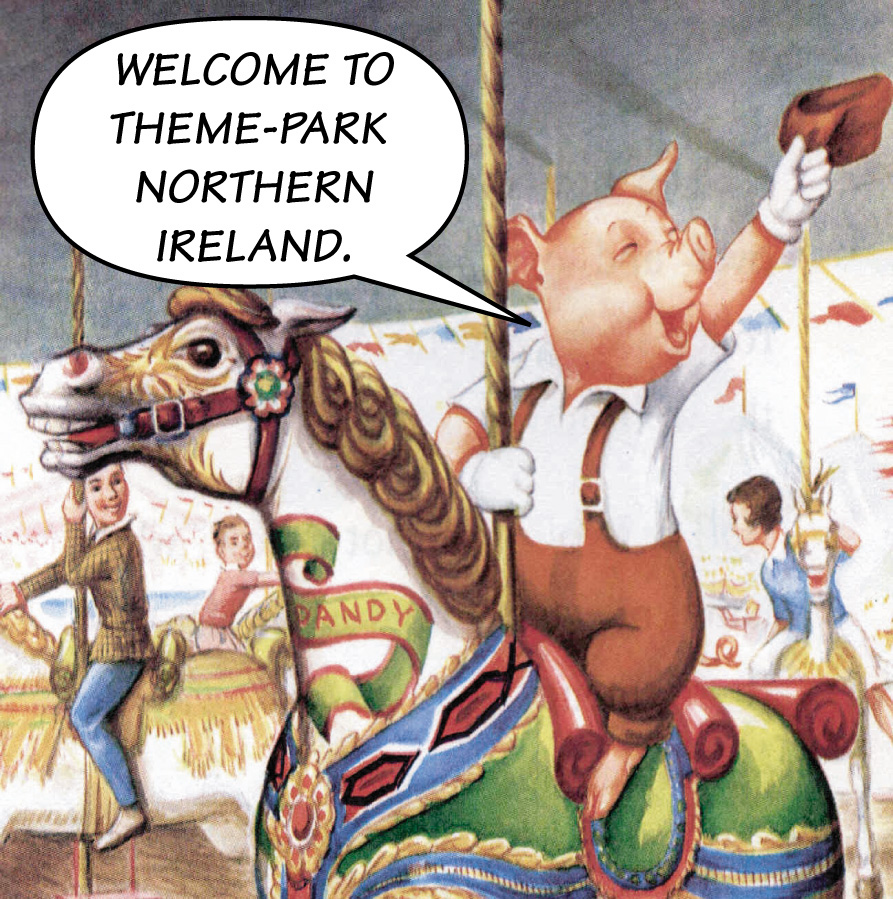 Yesterday, I saw an advert for Party Piglets and my mind flash-backed to a long-forgotten, damp evening on Victoria Street, where I once witnessed the disturbing sight of a group of morons waving and wailing from a British Army Saracen as it sped along the wet road. On recalling this moment, I felt as if a repressed abuse memory had surfaced.
On returning home, I checked out the Party Piglets website. Further horrors flickered into life on the computer screen. Here was a company that hired out British Army vehicles for the purpose of partying. These vehicles, which once cruised the streets, disgorging boy-faced soldiers with stern expressions and guns, now offered - according to the website - "the ultimate party experience."
In the 'Galleries' section, additional morons pose alongside Saracens, brandishing rifles and looking stupid. Local drag queen, Titti Von Tramp - not usually noted for her subtlety - is pictured astride an army jeep, legs akimbo. I think she is stimulating masturbation with a beer bottle in one picture, but I'm not entirely sure what might be going on. And if that's not enough, you can have a male stripper, dressed as an RUC man, if you so desire.
"The best craic I've had in years!" announces Kevin Connolly, editor of 'That's West Belfast' magazine on one of the website pages. Now, I'm sure I'd have heard of 'West Belfast Magazine' if it actually existed. I Googled it - and Mr Connolly - and came up blank. Surely the unscrupulous Party Piglets didn't invent it to give credence to their insensitive and crass enterprise?
Revisiting that rainy night in Victoria Street, I wondered how someone who had experienced the death of a loved one at the hands of the British Army might have felt on witnessing the drunk youngsters, shrieking hysterically from the speeding Saracen, feather boas fluttering in the slipstream.
Welcome to Theme-Park Northern Ireland. Here, every day's a party. Don't forget to pack your 'Lonely Planet' and don't mention the war.
Sunday, November 05, 2006
Awfully Awfully at Castleward Book Fair
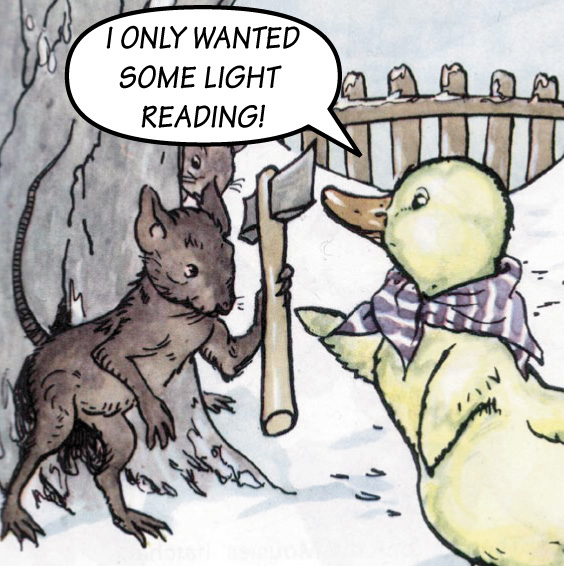 The Castleward Book Fair didn't advertise itself as an event where one had to pay admittance.
I pointed this out to the apologetic, elderly gentleman from the National Trust who greeted me as I arrived. He was embarrassed enough to forego the usual £3.80 per person entrancee fee and instead let me in for £1.80 - the child's fare.
Although charmed by his generous gesture, I was still somewhat disgruntled at having to pay anything into an event where I was expected to buy books, especially as the 18th Century mansion was closed to the public.
Anyway, the books were cheap and in plentiful supply. Colour stickers marked the £3 bargins from the £1 bargains and I even managed to get a copy of Ladybird's classic 'Downey Duckling' for 10p. I made my way to the pay point where elderly ladies with fixed grins and cut-glass accents rifled through the flyleaves in search of prices. I contested this attempt at flyness by pointing out the blue stickers on the spines of the books, denoting the price as £1 per book. The ladies gasped in humble apology and directed me to the bookshop next door, which I was informed held similarly priced goodies.
In the bookshop, a female customer, hobbling on a crutch, was in dialogue with another woman and a man, both of whom appeared to work in the shop. The women were dressed in tweeds and seemed to have modelled their appearances on Queen Elizabeth II. They held fixed-grin expressions and spoke with the most affected upper-class accents I've ever heard. As I made a play of browsing the shelves, I strained to ascertain the geographical location of said accents, but the feat was rendered impossible as the women's voices seemed to duel with one another to see who could sounded most royal. There was no geographical source for these voices. The entire performance was couched in crude snobbery. Irony was entirely absent.
"I wonder if you would suggest some light reading for me?" the woman with the crutch asked of the other woman. Her tone suggested she was more used to giving orders to servants.
"Why, I wouldn't know what kind of books you would like," answered the female shop assistant.
"I just need some light reading to send me to sleep," whittered the customer, ignoring the subtle protest of the other woman. "As long as it doesn't have any swear words. They're everywhere these days. It makes everything simply trying."
"One can't even go to the cinema," interjected the man, similarly accented. "It's wall to wall swear words. One for effect might be acceptable, but it's just wall to wall."
"It's dreadful," lamented the woman with the crutch, her tweed shifting uncomfortably.
"Oh look, there's one you might like," relented the female shop assistant. "'Sophie's World.'" She turned the book over and made a pretence of reading the back cover. "But who is Sophie?"
"I really need some light reading for when I get up in the night," the customer said. "We've mostly got biographies and such at home and I usually lose interest after a few chapters. I just get fed up. I really need some light reading."
"There's one. Hemmingway?"
"No."
"What about Barbara Taylor Bradford? 'Voice of the Heart'?"
"No."
"Joanna Trollope?" offered the shop assistant, examining another book, a pained expression creeping into her carefully maintained mask. "'Brother and Sister?'"
"No," the reply came, delivered in a bored tone.
"Oh, there's Dirk Bogarde."
"No."
"Oh, now look at that one," came the riposte. The shop asistant reached for a volume about the British Royal Family. She opened the pages and allowed her features to relax into quiet supplication. One would swear that sunlight poured from the photographs printed within as the general mood of the exchange improved considerably.
"Now, isn't that awfully telling," she said, pointing to a photograph. "That was taken just before they split up." She turned the book over. "It's by Jennie Bond."
"Didn't they get rid of her?" asked the woman with the crutch.
"Oh, yes," the other woman giggled. "They got rid of her, didn't they?"
"Oh, yes. They got rid of her."
"Oh, look. Kate Adie!" cried the shop woman, retreiving another book. "Philip and I are terribly impressed by her. Terribly impresed. You know, I said to my daughter, 'What do you want to do when you grow up?' and she siad, 'I want Kate Adie's job.' We're terribly impressed."
"Yes," came the reply. "It's not really light reading though, is it?"
"No, perhaps not," the shop woman said, disappointed at the rejection. She looked around at the books surrounding her, a vacant expresion on her face.
"Ronnie!" she cried. "Where's Ronnie?"
Enter Ronnie stage left.
"Here he is," purred the shop woman. "I call and angels descend." She flashed a row of pointed teeth at the other woman, who absently poked a nearby box of books with her crutch.
I wondered if I should intrude and ask the woman if she would mind picking out some books for me. I relented and left the claustrophobic shop.
I got into the car and turned on the radio. Radio Ulster was playing archive audio footage of the opening of Belfast's Queen Elizabeth Bridge on 4 July 1966 by Queen Elizabeth II. The shipyard workers - explained the plum-voiced announcer - were arranged on a floating pontoon, bedecked with red, white and blue bunting. Flags waved gaily. Queen Elizabeth II "very graciously" opened the bridge. She smiled and waved at the onlookers. The crowd cheered.
Friday, November 03, 2006
Queer and Loathing in Belfast
Since it'’s festival time in Belfast, I took myself along to the newly refurbished Grand Opera House to see Alan Bennett'’s 'The History Boys'’. I'’d avoided all spoilers, including the recent film, so I had no idea what the play was about. It's certainly witty. Bennett'’s one-liners and parochial observations are reminiscent of Quentin Crisp at his most acidic or Victoria Wood at her most deadpan.
However, I was most struck by Bennett'’s rendering of the three gay characters - although I use the word '‘gay'’ somewhat loosely, as it isn'’t mentioned in the text. Instead, we have the camp pupil Posner using the more clinical 'homosexual' - a word Bennett would probably use to describe himself.
The other homosexuals include Hector, an aging and inspirational teacher and Irwin, a younger and somewhat uncertain rookie teacher.
Hector is forced into early retirement due to his propensity for fondling the genitals of his unfazed male pupils, while transporting them on his motorbike. Irwin agrees to 'suck off' a pupil, before ending up in a wheelchair after a motorcycle ride with Hector. We'’re left to speculate whether or not Hector's hand wandered in the direction of Irwin's crotch during the motorcycle ride, which left Hector dead and Irwin paralysed, although the suggestion that improper queer fondlings lead to death and disability was clear.
The play ends with a rollcall, which details the future prospects of the pupils. They all go on to great wealth and success, except (you guessed it) Prosser, who ends up alone, his only friends being those of unspecified identity on the Internet. Oh well, at least he remembered his beloved Hector.
Recently, I saw Alan Bennett appear on TV to talk about '‘The History Boys'’. He mentioned his male partner, which surprised me, as I'’d taken Bennett to be one of those characters who skirted around the issue of his sexual identity. Perhaps the autobiographical content and success of 'The History Boys' has encouraged him to be more honest.
What worries me is that Bennett'’s own self-loathing has produced a play in which heterosexual characters flourish while gays are doomed to lives as either pederasts or lonely outsiders. More worrying is that such lazy and old-fashioned cyphers are delivered to a public who hoot with laughter and rain awards on the play.
As an aside, the public image of the gay male was further reinforced by Marie Jones and Maurice Bessman in their underwhelming play 'The Liverpool Boat' which is running at The Docker’s Club in Belfast. Thankfully, the most offending scene, in which a grotesque stereotype of a gay man was wheeled out for laughs (and they laughed uproarously) has been removed following complaints. Although painful to watch this ill-judged caricature, its setting in a working-mens club added insult to injury. One hopes, like another famous Belfast ship, 'The Liverpool Boat'’ sinks without trace.
Friday, October 06, 2006
Unionist Foot-soldiers Exit Stage Left
For an hour-and-a-half today, BBC Radio Ulster waxed lachrymose at the demise of the Royal Irish Regiment, with much mewing over the history of its former incarnation, the Ulster Defence Regiment (UDR).
Michael Copeland, a former UDR man, spoke to presenter Seamus McKee about how he and his companions in terror "Did their bit for Ulster." Phrases such as 'The Province' were scattered throughout this eulogy. He spoke in a sentimental fashion about a Catholic recruit, fearful of 'service' on the streets, who said: "What am I going to do on the streets of Londonderry? How can I come out against my own community?" One would imagine that usage of the term 'Londonderry' would provide an adequate solution to that problem.
"You can almost hear the thoughts of people," gurgled Seamus McKee in a reverential tone as he described the widows and families gathered at the Balmoral Showgrounds in Belfast. His faux-plummy accent was choked with equally faux remorse.
A UDR Greenfinch was interviewed. She described her pride at serving in the UDR, noting her duties as a security searcher in Belfast during the 1970s. I recalled a story from a friend, whose baby sister had her pram searched going through those 1970s security barriers. The child's mother hoped the baby would void its bowels as the Greenfinch attempted to search its nappy.
I also remembered an occasion when, stopped by a UDR patrol, I was questioned by a pig-faced soldier who asked me my address. I told him and the answer didn't suffice. He asked for my previous address, which also didn't compute. I had lived at many addresses over the years, primarily in ethnically mixed areas. Unable to determine my religious background, the pig-faced creature grew red with fury and apoplexy. But this is a minor complaint compared to the murders, the collusion, the harassment and the rifle butts in the face suffered by others.
Back at the Balmoral Showgrounds, a commentator noted the presence of the great and good from within unionism - Reg Empey, David Trimble, Archbishop Robin Eames, Jeffrey Donaldson, David Forde, Lord Alderdyce, Ian Paisley and Ian Paisley The Next Generation.
Alasdair McDonnell from the SDLP was also there. I wondered what had brought him to this carnival of unionism. Didn't someone tell him about the long history of UDR collusion with loyalist paramilitries? Didn't he know that nineteen members of the UDR were convicted of murder? Has he ever wept into his tea at the dreadful killings of the Miami Showband?
Cue a rather magnanimous Brian Feeney, obviously wheeled on to give some sense of balance to the unfolding event. Mr Feeney wasted no time in assuring the listeners that the UDR was loathed by Catholics. He noted that members of the paramilitary Ulster Defence Association (UDA) often joined the UDR and made up 15% of the regiment between 1975 and 1976. He also reminded listeners that, up to 1980, it was perfectly legal to be in both the UDR and UDA.
Mr Feeney was swiftly cut off by Seamus McKee, who doubtless swooning in ecstasies, handed over to a commentator who described how Queen Elizabeth II had arrived, wearing a rather fetching suit and hat of purple, complete with a purple-edged umbrella, for alas, it was raining.
At this point, I felt compelled to switch on the TV to see this outfit in all its glory. There it was, resplendent in the rain with BBC Northern Ireland's Noel Thompson fawning like his aural counterpart on Radio Ulster.
The British national anthem was played. And played again. And again. Queen Elizabeth II craned her neck awkwardly to watch some helicopters fly overhead, a look of bored resignation etched on her face. She handed over The Conspicuous Gallantry Cross to the Royal Irish Regiment, paying them off in much the same way she payed off the equally abhorred RUC.
Soon after, a black limousine arrived to whisk Queen Elizabeth II back to the world of fresh air. The assembled dignitaries broke up into bewildered groups. The RIR marched up and down. The rain stabbed against the wet concrete.
Michael Copeland, a former UDR man, spoke to presenter Seamus McKee about how he and his companions in terror "Did their bit for Ulster." Phrases such as 'The Province' were scattered throughout this eulogy. He spoke in a sentimental fashion about a Catholic recruit, fearful of 'service' on the streets, who said: "What am I going to do on the streets of Londonderry? How can I come out against my own community?" One would imagine that usage of the term 'Londonderry' would provide an adequate solution to that problem.
"You can almost hear the thoughts of people," gurgled Seamus McKee in a reverential tone as he described the widows and families gathered at the Balmoral Showgrounds in Belfast. His faux-plummy accent was choked with equally faux remorse.
A UDR Greenfinch was interviewed. She described her pride at serving in the UDR, noting her duties as a security searcher in Belfast during the 1970s. I recalled a story from a friend, whose baby sister had her pram searched going through those 1970s security barriers. The child's mother hoped the baby would void its bowels as the Greenfinch attempted to search its nappy.
I also remembered an occasion when, stopped by a UDR patrol, I was questioned by a pig-faced soldier who asked me my address. I told him and the answer didn't suffice. He asked for my previous address, which also didn't compute. I had lived at many addresses over the years, primarily in ethnically mixed areas. Unable to determine my religious background, the pig-faced creature grew red with fury and apoplexy. But this is a minor complaint compared to the murders, the collusion, the harassment and the rifle butts in the face suffered by others.
Back at the Balmoral Showgrounds, a commentator noted the presence of the great and good from within unionism - Reg Empey, David Trimble, Archbishop Robin Eames, Jeffrey Donaldson, David Forde, Lord Alderdyce, Ian Paisley and Ian Paisley The Next Generation.
Alasdair McDonnell from the SDLP was also there. I wondered what had brought him to this carnival of unionism. Didn't someone tell him about the long history of UDR collusion with loyalist paramilitries? Didn't he know that nineteen members of the UDR were convicted of murder? Has he ever wept into his tea at the dreadful killings of the Miami Showband?
Cue a rather magnanimous Brian Feeney, obviously wheeled on to give some sense of balance to the unfolding event. Mr Feeney wasted no time in assuring the listeners that the UDR was loathed by Catholics. He noted that members of the paramilitary Ulster Defence Association (UDA) often joined the UDR and made up 15% of the regiment between 1975 and 1976. He also reminded listeners that, up to 1980, it was perfectly legal to be in both the UDR and UDA.
Mr Feeney was swiftly cut off by Seamus McKee, who doubtless swooning in ecstasies, handed over to a commentator who described how Queen Elizabeth II had arrived, wearing a rather fetching suit and hat of purple, complete with a purple-edged umbrella, for alas, it was raining.
At this point, I felt compelled to switch on the TV to see this outfit in all its glory. There it was, resplendent in the rain with BBC Northern Ireland's Noel Thompson fawning like his aural counterpart on Radio Ulster.
The British national anthem was played. And played again. And again. Queen Elizabeth II craned her neck awkwardly to watch some helicopters fly overhead, a look of bored resignation etched on her face. She handed over The Conspicuous Gallantry Cross to the Royal Irish Regiment, paying them off in much the same way she payed off the equally abhorred RUC.
Soon after, a black limousine arrived to whisk Queen Elizabeth II back to the world of fresh air. The assembled dignitaries broke up into bewildered groups. The RIR marched up and down. The rain stabbed against the wet concrete.
Subscribe to:
Posts (Atom)